Sterilisation and Infection Control: How to Check a Dental Clinic Before You Sit Down
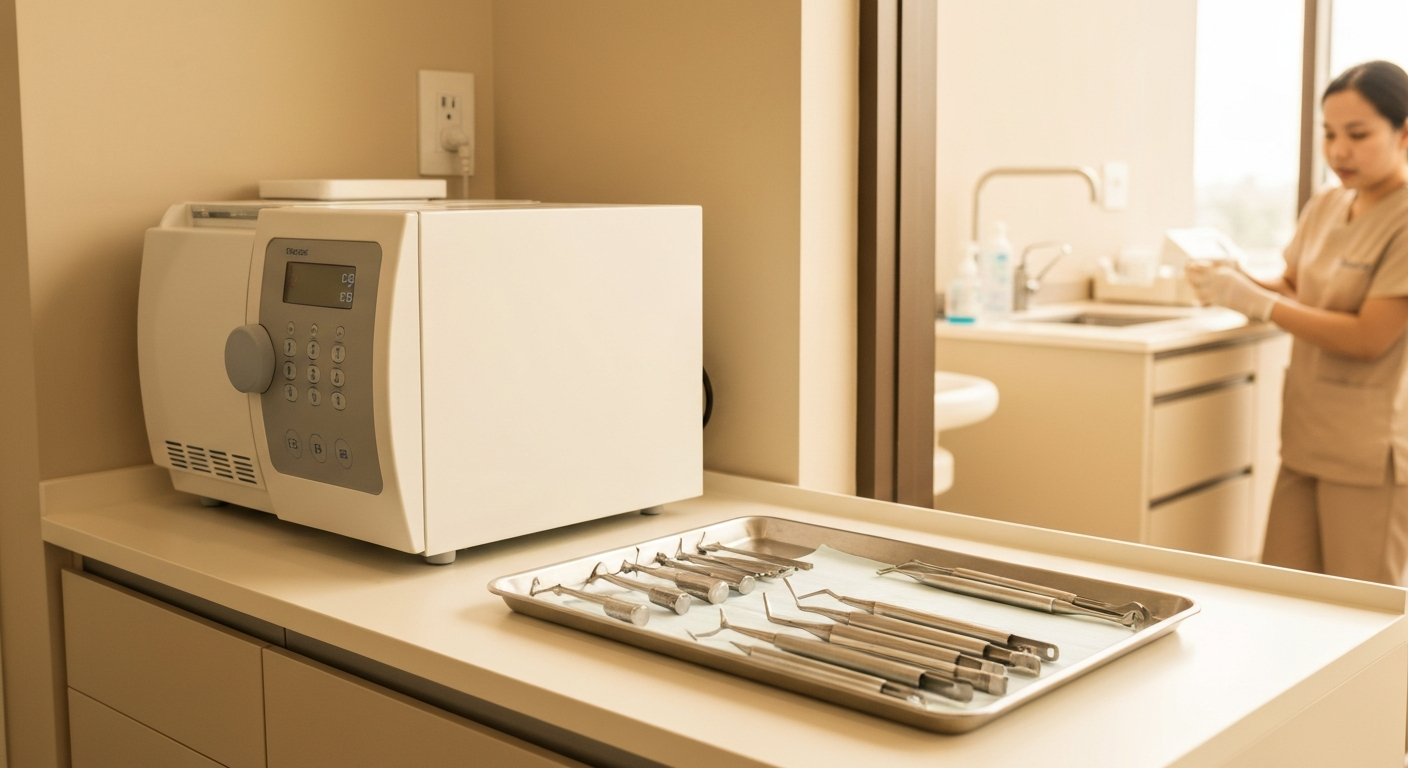
Quick Answer: Dental infection control standards are not country-specific. Steam sterilisation, sealed pouches, single-use sharps and barriers changed between patients are the same everywhere — the variable is the individual clinic. You cannot audit an autoclave from the dental chair, but you can watch instruments come out of a sealed pouch opened in front of you, check the indicator has changed colour, look at how the room is reset, and ask four direct questions that a good practice answers in seconds.
This is the anxiety that survives every other reassurance. You can accept that Philippine dentists are licensed and that the implant in the box is the same implant sold in London, and still sit down in a chair 7,000 miles from home wondering what happened to the instrument tray before it arrived. Below is what actually happens between patients, and the handful of it you can observe yourself.
What “sterilisation” actually means here
Three different processes get flattened into one word, and separating them is most of the battle. Cleaning removes visible debris, usually in an ultrasonic bath or a washer-disinfector. Disinfection reduces microbes on surfaces that cannot be put in a machine — the chair, the worktop, the light handle. Sterilisation is the highest bar: pressurised steam in an autoclave, intended to destroy everything present including bacterial spores.
Instruments follow a one-way route. They go from the treatment room to a dirty area, get cleaned, are inspected and dried, then sealed into a pouch, then run through the autoclave, then stored sealed until the moment they are opened for the next patient. A clinic with a properly organised sterilisation room keeps dirty and clean flowing in one direction and never back.
Worth knowing where the chain usually strains: it is rarely the machine. It is handling after the cycle — a pouch torn in a drawer, an item unwrapped early and left on a tray “ready” for the afternoon.
What a class B autoclave does
An autoclave sterilises with steam under pressure, and the cycle type decides what it can safely process. Under EN 13060, the European standard for small steam sterilisers, cycles are classified as B, N or S. A type B cycle pulls vacuum phases before and after the steam phase, which forces steam into hollow instruments and through wrapping — that is why it is the one clinics advertise. A type N cycle is non-vacuum and is only valid for unwrapped solid instruments. Type S sits between the two and is defined by the manufacturer for a specified load.
The distinction matters because dental handpieces are hollow. Air trapped inside a lumen stops steam reaching the surface, and unreached surfaces are not sterilised. Standard steam cycles run at 134 °C or 121 °C at pressure, with the lower temperature held longer.
If a clinic says “class B”, it will have the machine’s documentation and its cycle records. Asking to see them is reasonable.
The pouch is the part you can actually see
The sealed pouch is the piece of this process a patient can read without any training, which makes it the practical place to look. Look for four things.
- A colour-changed indicator printed on the outside. It confirms the pouch went through a cycle. It does not, on its own, confirm the cycle succeeded.
- A date or cycle number written or printed on the pouch, so the load is traceable back to a machine record.
- An intact seal — dry, unbroken, not previously opened and folded over.
- It being opened in front of you, at the chair, rather than arriving already open.
That last one is the request people are shy about and shouldn’t be. Instruments are supposed to stay sealed until use anyway, so opening at the chair costs the clinic nothing at all.
most of what a patient can see is a proxy, and you should treat it as one. A photograph of a gleaming autoclave on a clinic website is worth nothing — anyone can own a machine and run it badly. What you are really testing with these questions is whether the practice treats infection control as routine and answerable, or as an awkward topic. Watch the reaction as closely as the answer. A clinic used to foreign patients has fielded this a hundred times and will walk you through it without a flicker.
What should be single-use, and never reused
Some items are disposable by design, and the packaging says so — single-use products carry a crossed-out figure 2, the standard symbol for “do not reuse”. In a dental room that covers needles and anaesthetic cartridges, gloves, masks, bibs, suction tips and saliva ejectors, polishing cups and brushes, plastic barrier film, and the sleeve over a digital X-ray sensor.
Other items exist in both forms. Metal impression trays and many burs are reusable and must go through the full clean-pouch-autoclave cycle; their plastic and disposable equivalents go in the bin. Handpieces are the item worth asking about directly, because guidance is that they are heat-sterilised between patients rather than wiped down externally — and they are also among the more expensive items on the tray, which is exactly why a stretched practice might be tempted to cut the corner.
You will see the sharps bin in the room. A needle should go into it in front of you, not back onto the tray.
What good practice looks like between patients
The changeover is short, so watch it. A room being properly reset has a rhythm you can recognise even without knowing what each step is for.
- Barrier film comes off and goes on fresh — chair controls, light handle, headrest, keyboard or tablet, the air-water syringe.
- Uncovered surfaces get wiped with a disinfectant and left visibly wet for a moment, not flicked over with a dry cloth.
- Gloves come off before anything outside the treatment zone is touched. Someone typing notes or answering a phone in treatment gloves is a genuine lapse, and it is one of the easiest things in this whole article to spot.
- Hands are washed or alcohol-rubbed, then new gloves are opened.
- Water lines are flushed between patients.
None of this is hidden. Ask to sit in the room a moment before your appointment if you want to see a changeover, and treat a refusal as data.
Water lines and surgical irrigation
The tubing that feeds the drill and the air-water syringe is very narrow, and water sits still inside it overnight and over weekends, which allows biofilm to build on the inner wall. It is a known enough issue that infection control guidance treats it separately from instruments. Practices manage it by treating the lines with a maintenance product, flushing them at the start of the day and between patients, and periodically testing the output water.
The US CDC’s dental guidance sets a limit on bacterial counts in water used for non-surgical dental treatment, aligned with the standard applied to drinking water. For surgical procedures — implant placement, extractions, bone grafting — the guidance is different: a sterile irrigating solution is used rather than water drawn from the line.
So if you are travelling for implants rather than a cleaning, this is the water question that matters. Ask what irrigant is used during surgery.
The four questions, and what a good answer sounds like
Ask these by email before you book, then again in the room. The value is partly in the answers and partly in how fast they arrive.
- “How are instruments sterilised, and what class of autoclave do you use?” A good answer names the process and the machine class without hedging.
- “Do you spore-test the autoclave, and how often?” A biological indicator test is the only check that proves the machine kills spores. A practice that does this has records.
- “Are the instruments for my appointment opened in front of me?” The answer should be yes, immediately.
- “How are the water lines treated, and what irrigation is used for surgery?” Sterile solution for surgery is the answer you want.
A clinic that answers all four in a couple of sentences each has answered them before. One that goes vague, defers to “don’t worry, we are very hygienic”, or treats the question as an insult has told you something useful for free. The same logic runs through the ten questions to ask any clinic abroad and the red flags worth walking away from.
The honest framing: the standard is global, the clinic is not
Nothing described on this page is Philippine. The autoclaves come from the same manufacturers, the pouches and indicators are the same products, the published guidance comes from the same international bodies, and the physics of steam does not change at the border. There is no such thing as a Philippine standard of sterilisation that is separately lower or higher than a British or Australian one.
What does vary is whether a given practice holds to its own protocol on a busy Tuesday afternoon with three people waiting — and that varies inside every country, at least as much as it varies between them. Which is why “is dental work in the Philippines safe?” is the wrong shape of question, and we answer it that way too: you are not assessing a nation, you are assessing one building and the people in it.
Be honest about your own limits as well. You get one look at the room, on one day, as a visitor. That look is worth having, and it is not an audit. Combine it with the checks you can do from home — licence verification, reviews read for patterns rather than scores, a written itemised quote — because together they say more than any one of them alone.
Before you book
Run the ten questions to ask a clinic abroad before you pay a deposit, check the warning signs of a clinic to avoid, and read what happens if something goes wrong so you know what your recourse looks like from 7,000 miles away. Infection control is one of the things we look at in how we verify before a practice appears in our verified clinics. When you are ready, tell us your case on the enquiry form.
Sources
- Autoclave cycle classes (type B, N and S): EN 13060, the European standard for small steam sterilisers, which defines the three cycle types and the load each is validated for.
- Moist heat sterilisation generally, and the 134 °C / 121 °C cycle temperatures: ISO 17665 and standard steam-steriliser operating practice. These are general clinical and equipment-manufacturer practice rather than a single citable document, and the exact hold time depends on the machine and the load.
- Instrument handling, single-use items, handpiece heat sterilisation, spore testing and water-line management: CDC — Infection Prevention & Control in Dental Settings, the US Centers for Disease Control and Prevention’s summary of recommendations for dental health-care settings.
- Water quality limit for non-surgical dental treatment, and sterile irrigant for surgical procedures: CDC dental guidance, as above. The limit is expressed as a bacterial count aligned with drinking-water standards; we have not independently tested any clinic’s water.
- The “do not reuse” crossed-out 2 symbol: the standard graphical symbol used on single-use medical device packaging internationally.
- Philippine practice specifically: we have not sourced a distinct Philippine national dental infection-control regulation for this page. Where clinics here describe their protocols, they describe the same international guidance above. Treat any claim that Philippine standards differ, in either direction, as unsourced.
- What we check ourselves: how we verify, the process behind our clinic listings.
FAQ
How can I check a dental clinic's sterilisation without being a dentist?
Watch three things. Instruments should arrive in a sealed pouch and be opened in front of you, not sitting out on a tray. The pouch should carry an indicator that has changed colour, plus a date or cycle number. And the room should be visibly reset between patients — new barrier film, fresh gloves opened in front of you, a clean chair and headrest.
What is a class B autoclave?
An autoclave sterilises with pressurised steam. Under the European standard EN 13060, small steam sterilisers are classified by cycle type: a type B cycle uses vacuum phases before and after the steam, so steam reaches inside hollow instruments and through wrapping. Type N handles unwrapped solid instruments only. Type S sits in between and is defined by the manufacturer. Hollow items such as handpieces need the wider cycle.
What are the indicator strips on sterilisation pouches?
The printed strip on the outside is a process indicator: it changes colour when the pouch has been through a cycle. That confirms exposure, not success. Stronger clinics also place a chemical indicator inside the pouch, which reacts to the combination of steam, temperature and time. The real proof is a periodic spore test on the machine itself, which the clinic should be able to show you.
Can I ask a dentist to open the instruments in front of me?
Yes, and it is a normal request rather than a rude one. Instruments should be stored sealed until the moment of use anyway, so opening them at the chair costs the clinic nothing. How the question lands tells you as much as the answer does. A practice used to international patients will do it without comment; visible irritation is itself information.
What items should be single-use at a dental clinic?
Needles and anaesthetic cartridges, gloves, masks, bibs, suction tips and saliva ejectors, polishing cups and brushes, plastic barrier film, and the sleeve over an X-ray sensor. Single-use packaging carries a crossed-out figure 2 symbol meaning do not reuse. Other items, such as metal impression trays and some burs, exist in both reusable and disposable versions; reusable ones must go through the full sterilisation cycle.
Are dental water lines an infection control issue?
They are one of the things guidelines address specifically. The tubing feeding the drill and the air-water syringe is very narrow, water sits still in it overnight, and biofilm can form on the inner wall. Clinics manage this by treating and flushing the lines and testing the output water. For surgery, guidance is to use a sterile irrigating solution rather than water from the line.
Are sterilisation standards in the Philippines lower than in the US or UK?
The standards themselves are not country-specific. The equipment, the pouches, the indicators and the published guidance are the same internationally, and good Philippine clinics follow them. The variable is the individual practice and whether it holds to its own protocol on a busy day. That variation exists inside every country, which is why you assess a clinic rather than a nation.
What should I do if a clinic will not answer infection control questions?
Treat it the way you would treat a clinic that will not name the implant brand or put a quote in writing. There is no legitimate reason to be cagey about sterilisation, and it is not commercially sensitive information. Ask a second clinic the same questions and compare how they answer. You are choosing a practice, not committing to the first one you email.
This is general information, not medical advice. Smile Philippines is an independent directory and guide, not a dental provider. Prices are indicative ranges — confirm the current price and your treatment plan directly with a licensed dentist. See our full disclaimer.
Want clinic recommendations + a quote?
Tell us what you need — we'll match you with 2–3 verified clinics and reply within 48 hours.
Get a Free Quote →