Can a Balikbayan Get Dental Implants in One Trip Home? (2026)
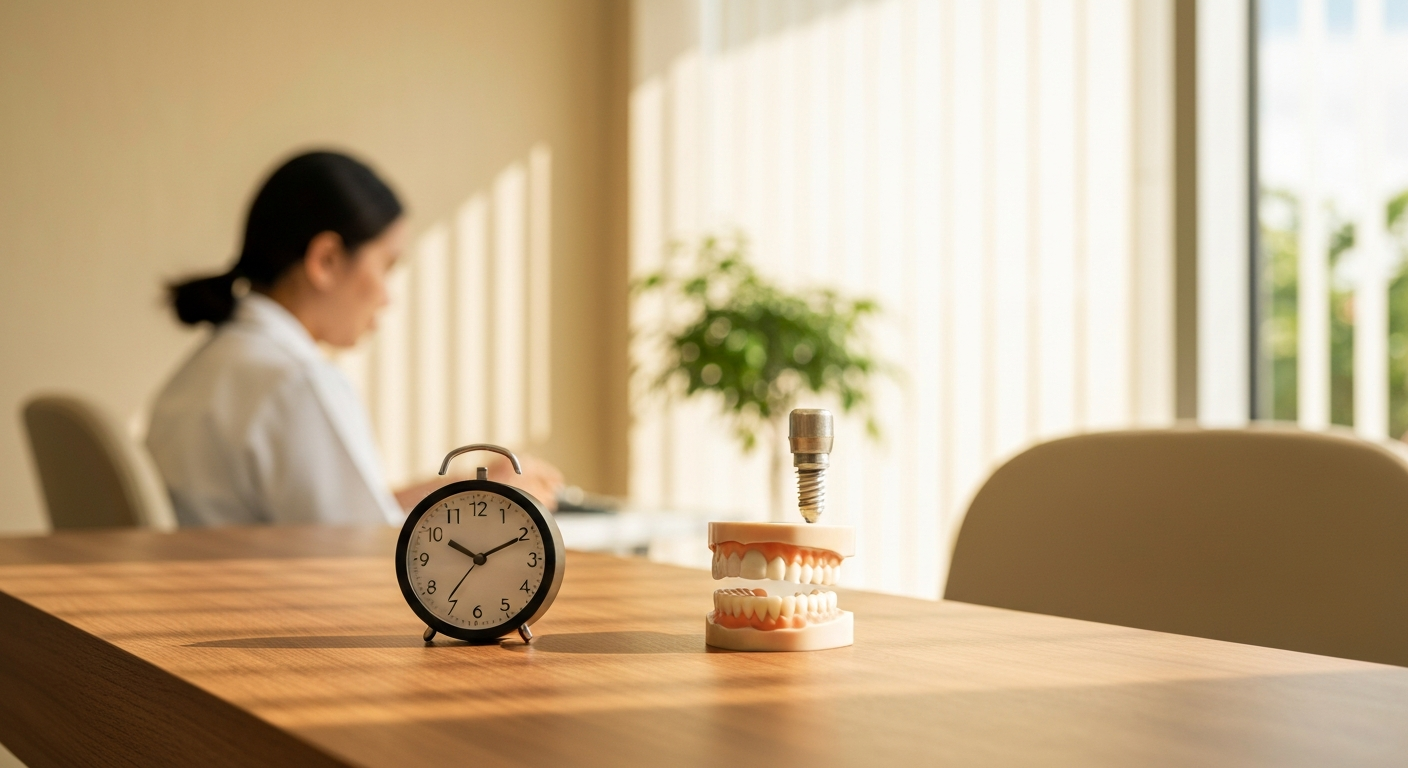
Quick Answer: For a conventional implant, no — the fixture needs roughly three to six months of osseointegration before it can carry a crown, and no clinic can shorten that. Immediate-load protocols put a temporary tooth on at surgery and are common in full-arch cases, but candidacy is decided by bone quality on a CBCT scan, not by your flight dates. What one trip home can finish is the whole surgical stage: scan, extractions, grafting, placement — the expensive part. The final tooth belongs to your next visit.
This question comes up constantly among balikbayans, and for a good reason: you are home for three weeks, the prices are a fraction of what you pay abroad, and it feels absurd to fly back for one appointment. The honest answer is not the one most clinics lead with, so here it is with the reasoning attached.
Can you get implants done in a single trip home?
For a conventional implant, usually not. The surgery itself takes an hour or two and the healing of the gum takes days, but the implant has to fuse with your jawbone before it can take a crown and a normal bite. That process runs about three to six months. It is the same in Manila as in Los Angeles or Sydney, because it is bone biology rather than clinic scheduling.
What a single trip can complete is everything up to that point. A typical first visit covers consultation and a panoramic X-ray or CBCT scan, extraction of any failing tooth, a bone graft or sinus lift if the scan calls for one, implant placement, and a review before you fly. That is 7-10 days of appointments with tourist time in between, and it is where most of the cost sits. See how many days implants take for the day-by-day version.
Why does osseointegration take three to six months?
Because bone remodels slowly. After placement, the surrounding bone resorbs slightly and then grows onto the implant surface until the fixture is locked in mechanically and biologically. Loaded too early, before that bond is strong enough, an implant can develop micro-movement and fail — and a failed implant means removal, months of healing, often a graft, and starting again.
The exact interval depends on where the implant sits and what the bone is like. Dense lower-jaw bone integrates faster than the softer bone at the back of the upper jaw, and a site that needed grafting usually needs its own healing period before an implant even goes in. That is the single most common cause of an unexpected extra trip, so ask about it directly. Bone grafting and sinus lifts explains which cases need it and what it adds — ₱15,000-₱40,000 for a socket or ridge graft, ₱20,000-₱50,000 for a sinus lift.
What immediate loading actually is
Immediate loading means a temporary crown or bridge is attached at or shortly after surgery, so you leave with a tooth rather than a gap. It is a real, established approach, not marketing. But it does two things people confuse.
It solves the cosmetic and functional problem of the healing months. It does not remove the healing months. The temporary is usually made light, sometimes deliberately kept out of full bite contact, and the definitive restoration is fitted once integration is confirmed — months later. So even a successful immediate-load case is a two-visit case for you; it just means you are not toothless in the photographs at your niece’s wedding.
Candidacy hinges on how much good bone is there, where the implant sits, and how tight the fixture is at the moment it is placed. Your surgeon may plan for immediate loading and change the decision in theatre if the implant is not stable enough. Same-day dental implants covers who qualifies in more detail.
Why full-arch cases are the ones that fit one trip
Full-arch protocols like All-on-4 are designed around immediate loading, which is why balikbayans replacing a whole arch often do get teeth on the first trip. Four or more implants are placed at angles chosen for the best available bone, then splinted together under a single fixed temporary bridge. Splinting spreads bite forces across all of them, so no individual implant carries the load a lone implant would.
That makes one surgical trip a normal plan rather than an exception. It is still not one total trip: the temporary bridge is replaced with the definitive prosthesis after healing, and that fitting usually needs 10-14 days because full-arch work involves try-ins and adjustment. If your visits home are annual, the rhythm works out neatly — surgery this year, final bridge next year. See the All-on-4 cost guide for what each stage covers.
What a clinic is telling you when it promises one trip by email
Nothing about your jaw, because it cannot know. Immediate-load candidacy is judged from imaging, from the surgical site itself, and from primary stability measured at the moment of placement. Anyone committing to a one-trip outcome before seeing a CBCT scan is making a scheduling promise, not a clinical one.
The pattern to watch for is a clinic that mirrors your constraint back at you. You say you only have 18 days; they say 18 days is fine. A clinic doing this properly asks for your imaging, tells you what it would need to see, and gives you a plan with a decision point in it — as in, “if the bone at site 26 is what we expect, we can load immediately; if not, you will be in a temporary partial and we crown it next visit.” That is what a real answer sounds like. Dental tourism red flags has the wider list.
“teeth in a day” almost always means a temporary tooth in a day. That is a genuine benefit and worth having, but a fair number of patients fly home believing the treatment is finished, then never come back for the final restoration because nobody was blunt about the second visit. Ask one question in writing before you pay a deposit: is the tooth I fly home with the final one, or a temporary? If the answer is a temporary, ask when the definitive restoration is due and what happens if you are late for it. A clinic that answers that clearly is one worth trusting.
What to do if you genuinely cannot come back
Some people cannot. Visits home are expensive, leave is limited, and an elderly parent’s next trip may be uncertain. In that case the right move is to say so at the consultation rather than hoping it works out, because there are legitimate alternatives that finish inside one visit.
- A bridge. Completed in one trip once the site has healed enough, and a well-made bridge lasts years. Zirconia crowns run ₱15,000-₱45,000 per tooth, so a three-unit bridge is far cheaper than an implant. The trade-off is that it involves the neighbouring teeth. See bridge vs implant.
- A denture. Complete dentures are ₱10,000-₱30,000 per arch and can be made within a trip, though they need adjustments afterwards, which is the part travellers struggle with. For parents in particular this is often the practical answer — dentures for balikbayan families.
- Stage it deliberately. Do the extractions and grafting on this visit, let the site heal for a year, and place the implant on your next trip when you can commit to both legs. Nothing is wasted and the timeline stops fighting you.
Why an unfinished implant is the worst outcome available
Of every way this can go, abandoning a placed implant is the one to avoid. You have paid for the surgical half — ₱50,000-₱150,000 for a single implant, before any grafting — and received none of the benefit. What sits in your jaw is a fixture with a cover or healing screw on it, which is not designed to be a long-term state. Gum tissue can grow over it, the site is awkward to keep clean, and the longer it sits the more likely it needs attention before it can be restored.
It also makes you an inconvenient patient at home. A dentist in the US, Australia or the Gulf inheriting an unrestored fixture has to identify the brand, source matching components and take responsibility for someone else’s surgery, and many decline. That is why the second trip should be booked, or at least diarised, before you leave the Philippines the first time.
| Procedure | Philippines | USA | You save |
|---|---|---|---|
| Single implant (complete) | ₱50k–150k ($822–$2,468) | $3,000–$6,000 | ~$2,900 at midpoints |
| All-on-4 (per arch) | ₱400k–800k ($6,580–$13,160) | $20,000–$35,000 | ~$17,600 at midpoints |
Single implant (complete)
All-on-4 (per arch)
Philippine prices are verified June 2026 from named clinics (how we verify); US figures are typical private ranges. We have sourced home-market implant prices for the US, UK, Australia, Canada and several other markets, but not for crowns, bridges or dentures — so the peso figures above for those are Philippine prices only, not comparisons.
How to plan it across two visits home
- Send your records ahead. Recent X-rays, a CBCT if you have one, and a list of medications. A clinic cannot answer the one-trip question without them.
- Ask for the plan with the decision points in it, not just a total price. You want to know what changes if the bone is thinner than expected.
- Put the surgery early in the trip. Not the day before your flight. Complications show up in the first few days and you want to be near your surgeon — see flying after implant surgery.
- Book or diarise the second visit before you leave, while the case is fresh and the clinic can hold your slot.
- Take your records home: implant brand, size, batch number, surgical notes and every scan. You need these whether you return or not.
- Bundle the rest of the family’s work into the same trip — that is where the balikbayan economics genuinely beat everyone else’s, since the flight is already paid for.
Before you book
Read the balikbayan dental guide for how to fit treatment around a family visit, the dental tourism timeline for every procedure’s realistic schedule, and the implant cost breakdown to price your own case. When you are ready, tell us your situation on the enquiry form and we will match you with verified clinics.
Sources
- Osseointegration interval (roughly three to six months before loading a conventional implant): standard implant protocol rather than a single citable document; intervals vary with bone quality, site and whether grafting was needed. Your surgeon’s plan for your jaw takes precedence over any general timeline, including this one.
- Immediate loading and full-arch splinting: established clinical practice, described here in general terms. Candidacy is judged case by case from imaging and from implant stability at placement — we are describing how the decision is made, not making it.
- Philippine prices (implants, All-on-4, crowns, dentures, grafts, sinus lift): named-clinic price research by the team behind ClinicFinderPH, verified June 2026 — how we verify.
- US implant and All-on-4 ranges: typical private-practice pricing shown as a range, not survey data.
- Exchange rate (₱60.79 = US$1, mid-market): ECB via Frankfurter, 12 June 2026. Confirm before you pay.
- Bridge, denture and crown costs outside the Philippines: not stated here, because we have no verified home-market figures for those procedures. Get a written quote at home to compare against.
FAQ
Can I get a dental implant placed and crowned in one trip home?
For a conventional implant, usually not. The fixture has to osseointegrate — bone grows onto its surface until it can carry a crown and normal bite forces — and that generally takes three to six months. A clinic can place the implant on this visit and fit the final crown on your next one. Immediate-load protocols compress that, but only for patients whose bone quality supports it, and that is judged from a scan.
What is immediate loading, and does it mean I am finished in a week?
Immediate loading means a temporary tooth or bridge is fitted at or near the time of surgery, so you do not walk around with a gap. It does not mean the treatment is complete. The temporary is deliberately light and often kept out of heavy bite contact while the implant integrates. The final restoration is still fitted months later, so you should plan a second visit regardless.
Why are full-arch cases more often done in one surgical trip?
Because All-on-4 and similar protocols spread the load across several implants splinted together by one fixed bridge, which stabilises the whole arch in a way a single free-standing implant is not. That design makes immediate loading realistic for many full-arch patients. It still ends with a second trip for the final prosthesis, so it is one surgical trip, not one total trip.
What should I think if a clinic promises one-trip implants before seeing my scan?
Treat it as a sales answer rather than a clinical one. Candidacy for immediate loading depends on bone volume and density, implant position, how stable the fixture is once placed, and your bite. None of that is knowable from an email. A clinic willing to commit to your calendar before seeing imaging is telling you what its priorities are.
What can one trip home realistically finish?
Plenty. Extractions, cleanings, fillings, crowns, veneers and dentures fit comfortably into 7-14 days. On the implant side, one trip can complete the whole groundwork stage — scan, extractions, bone graft or sinus lift if needed, and implant placement — which is the expensive, surgical part. What it cannot compress is the healing gap before the final tooth goes on.
What are my options if I genuinely cannot come back?
Talk to the clinic about a bridge or a denture instead, which can usually be completed within one visit, or about staging the implant work to start on a future trip when you can commit to both legs. A bridge or denture done properly beats an implant abandoned halfway. Discuss the trade-offs with a dentist who has examined you rather than deciding from an article.
What happens if I never return for the second stage?
You are left with a fixture in your jaw and no tooth on it, and a healing screw or cover that was never designed for years of service. Gum can grow over it, hygiene around it gets awkward, and you have paid for the costly half of the treatment without getting the part you actually wanted. Any dentist at home then inherits a case they did not plan.
Can I have the implant placed in the Philippines and crowned at home?
Sometimes, but arrange it before you fly, not after. Your home dentist has to be willing to restore another surgeon's fixture, and needs the implant brand, size, batch number, surgical notes and scans to order the right components. Get written confirmation from both sides first. Also compare the cost, since restoring at home can erase a good part of the saving.
This is general information, not medical advice. Smile Philippines is an independent directory and guide, not a dental provider. Prices are indicative ranges, verified June 2026 — confirm the current price and your treatment plan directly with a licensed dentist. See our full disclaimer.
Want clinic recommendations + a quote?
Tell us what you need — we'll match you with 2–3 verified clinics and reply within 48 hours.
Get a Free Quote →