Single Tooth Implant in the Philippines: Cost, Timeline and When Not to Fly
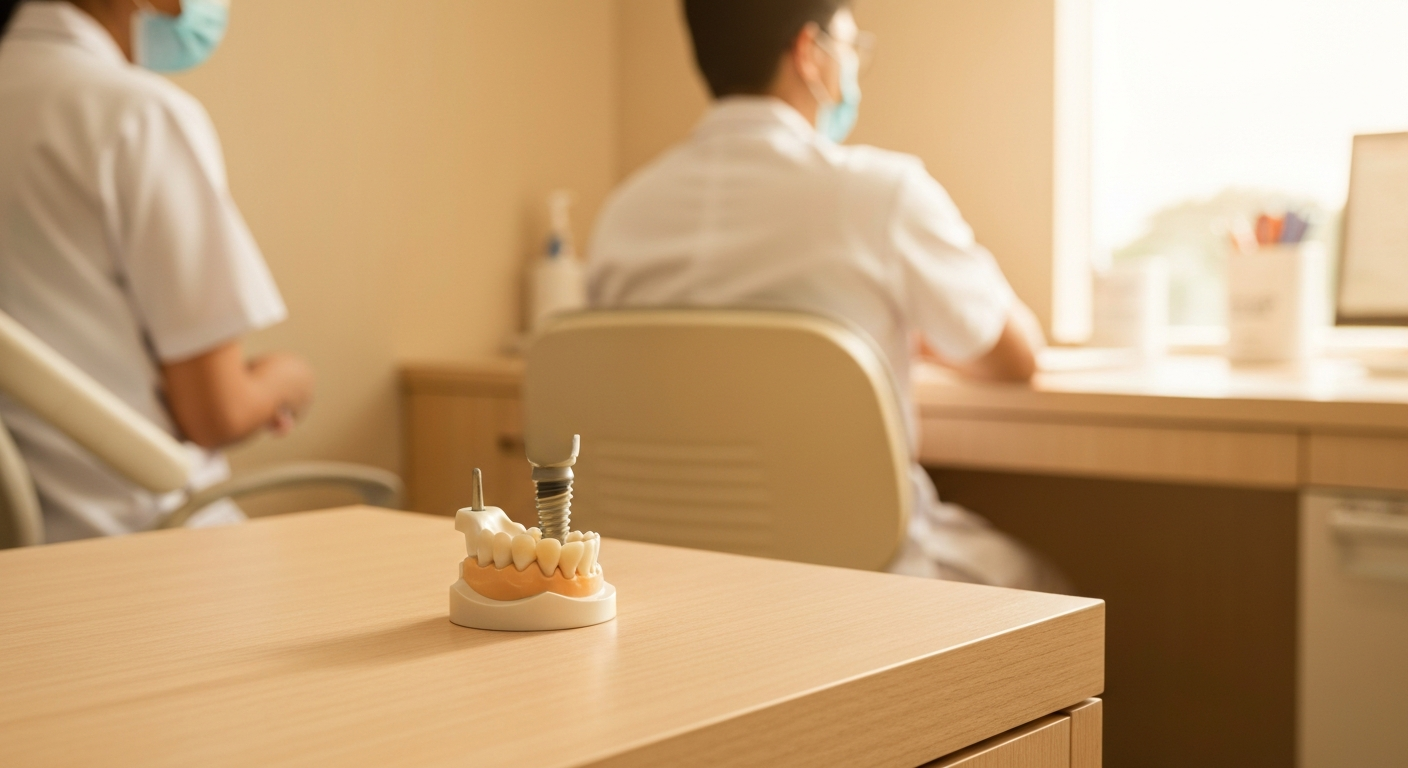
Quick Answer: One dental implant in the Philippines costs ₱50,000–₱150,000 (about US$822–$2,468) in 2026, and the fixture brand drives almost all of that spread — Korean and Israeli systems at ₱40,000–₱80,000, US and Swiss at ₱70,000–₱150,000. It normally takes two trips, three to six months apart. The saving against US prices is roughly $2,900 at the midpoints, which is real money but not enough to pay for two long-haul return flights. One tooth is the case where the travel maths usually fails.
This page is the opposite of a sales pitch. A single implant is the treatment we most often tell people to have done at home, so the useful thing we can give you is the itemised cost, the honest timeline, and the arithmetic that decides it either way.
What a single tooth implant costs in the Philippines
Most quotes for one tooth land between ₱50,000 and ₱150,000 — about $822–$2,468 at the June 2026 rate of ₱60.79 = US$1. Which end you land on is mostly the implant system the clinic stocks, not the city you fly to.
| Line item | Philippines | USA | You save |
|---|---|---|---|
| Single implant — Korean/Israeli system | ₱40,000–₱80,000 ($658–$1,316) | $3,000–$6,000 | ~$1,700–$5,300 |
| Single implant — US/Swiss system | ₱70,000–₱150,000 ($1,152–$2,468) | $3,000–$6,000 | ~$530–$4,850 |
| Bone graft (socket or ridge), if needed | ₱15,000–₱40,000 ($247–$658) | no sourced figure | — |
| Sinus lift, if needed | ₱20,000–₱50,000 ($329–$823) | no sourced figure | — |
| Panoramic X-ray | ₱1,000–₱2,500 ($16–$41) | no sourced figure | — |
Single implant — Korean/Israeli system
Single implant — US/Swiss system
Bone graft (socket or ridge), if needed
Sinus lift, if needed
Panoramic X-ray
Philippine figures are verified June 2026 from named clinics (how we verify); the US range is aggregator pricing, and we hold no sourced US figure for grafting or imaging, so those rows are left blank rather than guessed. The full implant cost breakdown has the wider picture including multi-tooth and full-arch work.
What the quote has to itemise
A single-tooth quote should be seven lines, not one number. The whole point of itemising is that you can see what has been left out before you are sitting in the chair with a flight home booked.
- Consultation and the treatment plan itself.
- Imaging — a panoramic X-ray at ₱1,000–₱2,500, or a CBCT scan if the site is close to the sinus or the nerve.
- Extraction, if the tooth is still there.
- Bone graft or sinus lift, if the site needs one — see grafting and sinus lifts for what these involve and why they add months, not just pesos.
- The fixture, with the brand and model written down.
- The abutment, the connector between fixture and crown.
- The crown, with the material named. Philippine crown pricing verified June 2026 runs ₱8,000–₱15,000 for porcelain-fused-to-metal and ₱15,000–₱25,000 for zirconia per tooth, so a vague crown line can move your total by ₱17,000.
Then the warranty, in writing. A quote without one is incomplete, and so is a quote that does not say what happens if the scan changes the plan once you land — that is the moment a ₱60,000 case becomes a ₱110,000 one once a ₱50,000 sinus lift joins it, and you want the clinic’s answer on paper while you are still at home and free to walk away.
Why two clinics quote the same tooth so differently
The gap between a ₱55,000 quote and a ₱140,000 quote for the same missing tooth is almost never about the city or the marble in the reception. It comes from four variables, and you can ask about all four by email.
The fixture brand is the biggest. Korean and Israeli systems sit at ₱40,000–₱80,000 and premium US and Swiss systems at ₱70,000–₱150,000 — the implant brands guide explains what the extra buys you, which is mostly research history and worldwide parts availability rather than a different outcome on a straightforward case. The crown material is second. Grafting is third, and it is the one that most often appears after the scan rather than before it. Fourth is who places the implant — a surgeon with implant training or a general dentist. That last one is the variable with the least effect on price and the most on outcome, which is exactly the wrong way round from how quotes are usually read.
How long one implant takes
Plan on two trips, three to six months apart, unless a clinic has confirmed in writing that you are a candidate for immediate loading. The gap is not administrative — it is the fixture fusing to the bone, and it cannot be shortened by paying more.
Trip one, roughly 5–10 days: consultation, imaging, extraction if the tooth is still present, grafting if the site needs it, placing the fixture, and a review appointment before you fly. If a graft is involved, the healing window before the crown can be at the longer end.
Trip two, roughly 5–7 days: the abutment is fitted, impressions or a digital scan are taken, the laboratory makes the crown, and it is fitted and adjusted. Adjustment appointments are the reason you should not book the flight home for the morning after the crown goes in.
How many days implants take has the day-by-day schedule for both visits.
When a bridge is the better answer
A conventional bridge is often the cheaper and faster route for one missing tooth, because it is laboratory work rather than surgery: no fixture, no healing period, and no second trip three months later. That is a genuine advantage for a traveller.
The trade-off is structural. A three-unit bridge is anchored to the teeth on either side of the gap, and those teeth have to be prepared to take crowns even if nothing is wrong with them. An implant is free-standing and leaves the neighbours alone, but it requires enough bone in the right place, and it commits you to the two-trip timeline.
Which one is right for your mouth depends on the condition of those neighbouring teeth, your bone volume and your medical history — a judgement for the dentist who examines you and reads your scan, not for a website. Bridge vs implant in the Philippines sets out the comparison in full.
Does one tooth justify the flight?
Here is the number the travel arithmetic turns on. Against a Philippine midpoint of about $1,645, the saving on a single implant runs from roughly $1,080 to $2,900 depending on where you live — a real saving, and a small one next to two return flights.
| Where you live | Philippines | At home | You save |
|---|---|---|---|
| United States | $822–$2,468 | $3,000–$6,000 | ~$2,900 |
| Hong Kong | $822–$2,468 | $2,298–$5,106 | ~$2,050 |
| Singapore | $822–$2,468 | $2,726–$4,673 | ~$2,050 |
| Canada | $822–$2,468 | $2,145–$4,647 | ~$1,750 |
| Australia | $822–$2,468 | $2,111–$4,573 | ~$1,700 |
| United Kingdom | $822–$2,468 | from $3,216 | ~$1,570+ |
| United Arab Emirates | $822–$2,468 | $1,361–$4,084 | ~$1,080 |
United States
Hong Kong
Singapore
Canada
Australia
United Kingdom
United Arab Emirates
Savings compare midpoints and are indicative only. Notice that the dollar gap is similar from the US, Hong Kong and Singapore — so the gap is not what decides it. The airfare decides it. From Los Angeles or London you are buying two long-haul returns and roughly a fortnight of accommodation across both trips, which will usually consume the whole saving. From Singapore or Hong Kong you are buying two short-haul returns for the same gap, and it survives. Put your own two-flight quote into the sum before you decide; dental implants abroad runs the same comparison across every market we can source, and Philippines vs Singapore goes deeper on that route.
one implant is the weakest case in dental tourism, and anyone enthusiastically selling you a trip for a single tooth is selling the trip. The two situations where it does add up are when you are already travelling — visiting family, on home leave, or having other work done in the same visit — and when the flight is short-haul. If neither applies, have the tooth done at home and spend the saving on a dentist you can walk back to.
What the warranty has to say
Ask for the warranty before you pay a deposit, and read it for three things specifically, because a single implant is the case where a failure hurts most in proportional terms — a redo at home prices can cost more than the whole trip saved.
First, what is covered and for how long — the fixture and the crown usually carry different terms, and the crown’s is normally shorter. Second, who pays to fix it: whether the clinic covers only the replacement parts and chair time, or also the return airfare and accommodation. Third, what voids it, which commonly includes missing review appointments, so know what you are agreeing to before you fly home.
Then collect the paperwork on the day: implant brand, model, batch label, diameter and length, surgical notes, and your scans before and after. A dentist at home cannot safely service a fixture they cannot identify, and this is the part that is easiest to leave behind. Ask for it by email as well as on paper, so it survives a lost folder. It costs the clinic nothing to send, and a clinic that hesitates has told you something useful about how the warranty conversation would go later.
Before you book
Read the full implant cost breakdown to see how the numbers change once you are replacing more than one tooth, then the implant brands guide so you can ask for a named system on your quote. When you have your treatment plan, send us your case on the enquiry form and we will match you with verified clinics — including telling you when the trip is not worth taking.
Sources
- Philippine prices (single implant ₱50,000–₱150,000; Korean/Israeli fixture ₱40,000–₱80,000; US/Swiss fixture ₱70,000–₱150,000; bone graft ₱15,000–₱40,000; sinus lift ₱20,000–₱50,000; panoramic X-ray ₱1,000–₱2,500; PFM crown ₱8,000–₱15,000; zirconia crown ₱15,000–₱25,000 per tooth): named-clinic price research by the team behind ClinicFinderPH, verified June 2026 — how we verify. Zirconia can run higher than ₱25,000 at premium Manila clinics for imported or multi-layered work.
- US single implant ($3,000–$6,000): aggregators citing the American Dental Association Survey of Dental Fees, which is not published openly — e.g. CareCredit dental implant cost guide. We hold no sourced US figure for grafting, sinus lifts or imaging, which is why those cells say so.
- UK (from £2,400 for a complete single implant): Bupa Dental Care — cost of implants.
- Australia (A$3,000–A$6,500) and Canada (C$3,000–C$6,500): clinic and aggregator pricing. Neither the ADA (Australia) fee survey nor the provincial Canadian fee guides publish open per-item figures, so these are market ranges rather than survey data.
- Singapore (S$3,500–S$6,000), Hong Kong (HK$18,000–HK$40,000) and the UAE (AED 5,000–AED 15,000): published clinic pricing, 2026 — indicative ranges, not survey data.
- Implant brand tiers: Straumann, Nobel Biocare, Zimmer, Osstem, Hiossen, MIS and Dentium are globally distributed systems; the tier descriptions reflect established market positioning, not a clinical endorsement.
- The two-trip timeline, the three-to-six-month healing window, and the description of what a bridge and an implant each involve: general clinical and market practice in implant dentistry rather than a single citable document. Your own dentist’s assessment of your bone and your neighbouring teeth overrides anything on this page.
- Warranty terms and documentation practice: general market practice among Philippine clinics serving overseas patients; terms vary by clinic and are not standardised, which is why we tell you to read yours.
- Exchange rates (₱60.79 = US$1, ₱81.47 = £1, ₱47.34 = S$1, ₱7.76 = HK$1, ₱42.77 = A$1, ₱43.46 = C$1, ₱16.55 = AED 1): ECB reference rates via Frankfurter, 12 June 2026. Rates move daily — confirm before you pay.
FAQ
How much is a single tooth implant in the Philippines?
Quotes for one tooth land between ₱50,000 and ₱150,000, or about US$822–$2,468 at the June 2026 rate of ₱60.79 to the dollar. The fixture brand is what moves the number: Korean and Israeli systems are priced around ₱40,000–₱80,000, and US or Swiss systems around ₱70,000–₱150,000. Grafting, if your case needs it, is quoted on top.
Does the price include the crown?
At many Philippine clinics the per-tooth price already covers the fixture, the abutment and the final crown, but this is not universal, and it is a common source of a surprise bill. Ask the clinic to write down whether the crown is included, and if it is billed separately, which material it is. A quote that says only 'implant' is not a quote.
How many trips does one implant take?
Normally two, three to six months apart. The first trip covers the consultation, imaging, any extraction or grafting, and placing the fixture. The implant is then left to fuse with the bone before the second trip, when the abutment and final crown are fitted. Some cases are suitable for immediate loading, but that is a clinical judgement about your bone, not a scheduling choice.
Is one implant worth flying to the Philippines for?
From the US or the UK, usually not on its own. The saving on one tooth is roughly $1,570–$2,900 against home prices, and two long-haul return flights plus accommodation for both trips will often eat all of it. From Singapore, Hong Kong or the Gulf the flight is far shorter and the same gap survives. Run your own airfare through the arithmetic before booking.
What should be itemised on the quote?
Seven lines: consultation, imaging (panoramic X-ray or CBCT), any extraction, any bone graft or sinus lift, the implant fixture with brand and model named, the abutment, and the crown with its material named. Add the warranty terms in writing. If a clinic gives you one number with no breakdown, you cannot tell what has been left out until you are in the chair.
Is a bridge cheaper than a single implant?
Usually yes up front, because a bridge is laboratory work rather than surgery and needs no healing period. The trade-off is that a conventional bridge is anchored to the teeth either side, which have to be prepared, and an implant does not touch them. Which one suits your mouth depends on the condition of those neighbouring teeth and your bone, so it is a question for the dentist who examines you.
What happens if the implant fails after I fly home?
You pay a dentist at home to deal with it, at home prices, which can wipe out the saving on a single tooth entirely. That risk is proportionally much worse for one implant than for a full arch. Get the warranty in writing before you travel, including who pays for the return flight, and bring home the brand, model, batch label, size, surgical notes and scans.
Can I have the implant placed on one trip and the crown fitted at home?
Some patients do this, but it needs agreement from both dentists before anything is placed, because the dentist at home has to be willing to work with that implant system and able to order its parts. Ask your own dentist first. If they will not commit in advance, do not assume the plan will work once the fixture is already in your jaw.
This is general information, not medical advice. Smile Philippines is an independent directory and guide, not a dental provider. Prices are indicative ranges, verified June 2026 — confirm the current price and your treatment plan directly with a licensed dentist. See our full disclaimer.
Want clinic recommendations + a quote?
Tell us what you need — we'll match you with 2–3 verified clinics and reply within 48 hours.
Get a Free Quote →